Hippocratic AI: Healing Healthcare’s Workforce Crisis
By 2030, the world could be facing a silent crisis—one not of disease, but of absence. The World Health Organization warns of a looming shortage of 10 million healthcare workers globally.
In the U.S., the strain is already visible: the demand for home health aides is set to surge by 33%, and millions more nurses and care coordinators will be needed to care for an aging population. As hospitals and clinics stretch thin, artificial intelligence has appeared to be the savior.
Artificial intelligence is rapidly making its mark in healthcare, with many leading companies weaving it into their products to streamline operations and enhance patient care. Among the rising stars in this space is Hippocratic AI, a company that stands out for its unique approach. Rather than focusing on diagnostics or administrative automation, Hippocratic AI is developing safety-focused large language models (LLMs) specifically designed for non-diagnostic, patient-facing applications.
Before understanding why they chose a different path, we need to explore how Hippocratic AI came into existence.
When a Personal Health Crisis Sparked a Healthcare Revolution
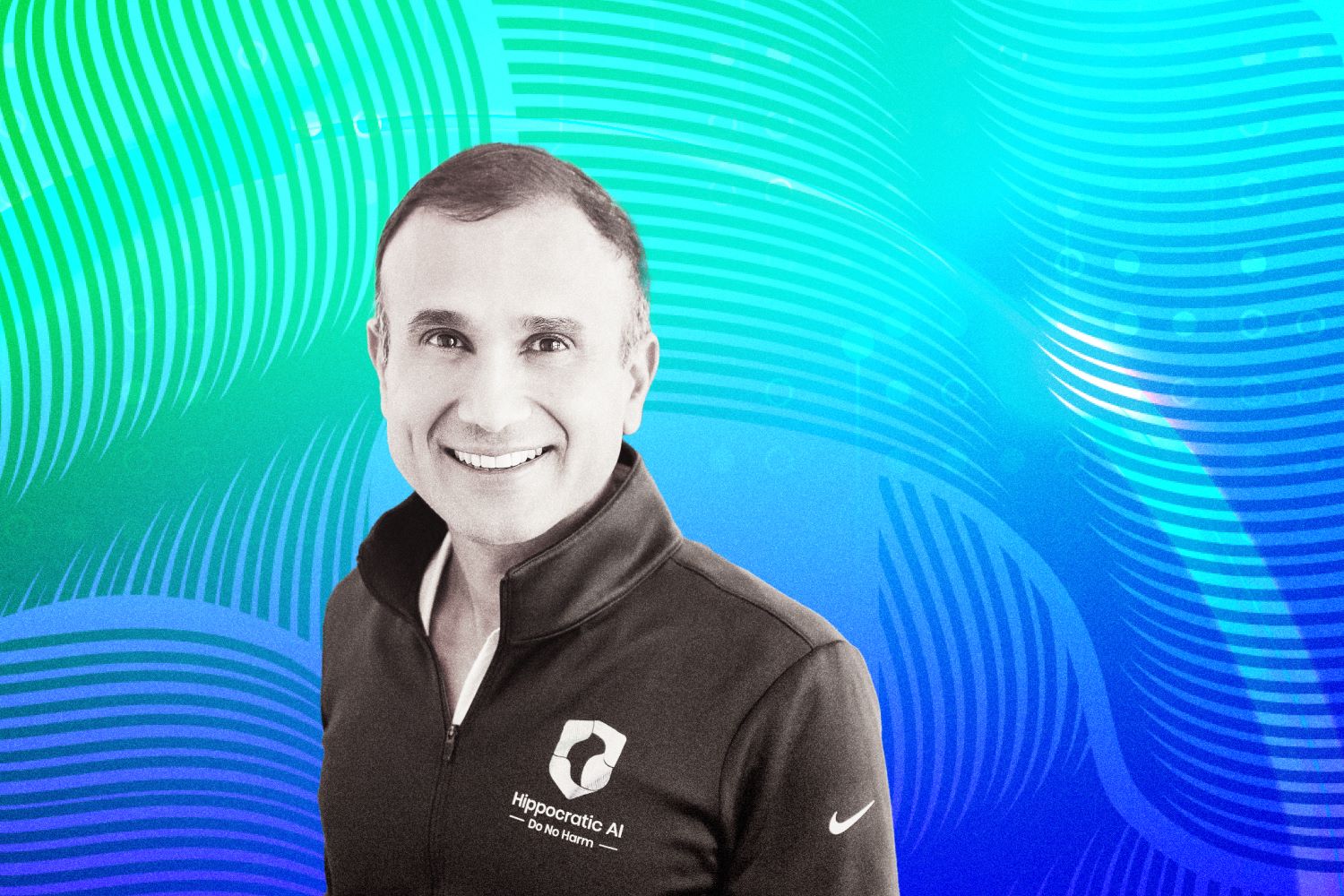
We often hear inspiring stories of founders who turn personal challenges into powerful innovations—and Munjal Shah, co-founder and CEO of Hippocratic AI, is no exception.
Munjal Shah is a serial AI entrepreneur with over 100 patents and a Master’s in AI from Stanford. He sold his first company to Alibaba and his second, a machine learning and computer vision startup (Like.com), to Google.
“I am a serious entrepreneur. I love building companies, and I love using them to try to make an impact on the world,” he stated in the MAD Podcast with Matt Turck.
The day after selling his previous company, Like.com, to Google, Shah experienced a serious health crisis.
“But then, the day after I sold the company—what should have been one of the best days of my entrepreneurial career—I ended up with chest pains and landed in the ER. I was 37 at the time. My father had his first heart attack in his mid-40s, so my genes weren’t exactly the best. I ended up losing 30 to 40 pounds. I’m not that tall a person, so that kind of weight loss was actually pretty significant for me,” he recalled.
That was the moment that he decided to shift his focus to healthcare and want to build a company in this field.
Since that moment, Munjal Shah has spent more than 10 years in healthcare, only to realize that building a company in this area is a daunting task. However, the turning point when he knew his ideas could become reality was when he saw the rise of ChatGPT a few years ago.
“I saw ChatGPT come out, and I said, ‘Oh my God. AI finally works,’” said the serial entrepreneur.
Driven by the potential of AI, Munjal Shah founded Hippocratic AI alongside physicians, hospital administrators, Medicare experts, and AI researchers from leading institutions such as Johns Hopkins, Stanford, Google, and Nvidia.
“This is the time. This is what I’ve been waiting for my whole career—to combine these two passions of mine,” he expressed.
A Life-Changing Moment
While many other companies focus on diagnosis, Munjal Shah, the founder of Hippocratic AI, chose to leverage large language models (LLMs) to tackle a different, often overlooked challenge in healthcare.
He believes that diagnosis is a high-risk area where mistakes can cause serious harm, and thus is not safe enough to be the primary focus of AI development. Instead, Munjal recognized that a vast majority of healthcare spending—approximately $3 trillion—goes toward non-diagnostic and non-drug-related care, such as ensuring patient adherence to treatment plans, providing ongoing support, and removing barriers to effective health management.
With his deep healthcare experience, Munjal saw LLMs as an ideal technology to address these issues by delivering personalized guidance and continuous attention, areas where traditional healthcare systems often fall short.
At Hippocratic AI, Munjal Shah and his team are harnessing the power of large language models (LLMs) in healthcare with three core ambitions in mind.
Reimagining How Healthcare Works
As shared by Munjal Shah, one way LLMs can be used in healthcare is to improve the productivity of doctors’ workflows—for example, helping them draft responses to patient messages (their “in-basket”), write notes, or communicate with insurance companies. While these tools can make certain tasks faster or easier—maybe improving efficiency by 5 to 10 percent—this kind of improvement doesn’t significantly transform healthcare overall.
“They maybe make you five percent more efficient, ten percent more efficient. It’s not clear if you make somebody ten percent more efficient that they see ten percent more patients, right? In fact, if they’re right now spending every evening answering their in-basket—which most doctors are—and that’s time they would rather have spent with their kids, when they get that ten percent back from that time, they spend it with their kids. Rightfully so. But that means the system didn’t get any efficiency. That means we didn’t see more patients. And that’s, you know, that’s what happens,” he explained.
When There Aren’t Enough Hands to Help
The second major way LLMs can impact healthcare is addressing the massive staffing shortage crisis.
During the pandemic, many healthcare workers, especially nurses, burned out and left the profession, creating a huge gap—around 20–30% understaffing—in the healthcare workforce globally, not just in the U.S. This shortage leads to extremely long wait times for patients, such as waiting years just to see a primary care doctor in places like Canada and the UK.
To tackle this, Shah explains that LLMs combined with voice technology can be used to automate certain healthcare tasks in virtual care settings. These AI-powered systems could call patients, handle routine tasks, and escalate complex issues to human staff when necessary.
This way can help to extend the reach and capacity of the existing healthcare workforce, giving much-needed relief without waiting years to train new nurses or doctors. Essentially, LLMs can act as a scalable solution to ease the staffing crisis by doing more with less human labor, improving access and efficiency in healthcare delivery.
“Solving the staffing crisis is really where we see a lot of the big ideas. And we’re going in and solving some of those things,” he stated.
Building an Army of AI Assistants
Munjal Shah’s third and most exciting idea is what he calls “super-staffing.” Unlike simply filling the existing staffing gaps, super-staffing imagines leveraging large language models (LLMs) to create a level of support far beyond what’s currently affordable or possible.
Running an LLM with voice capabilities costs just around 18 cents an hour — practically negligible compared to human labor costs. This drastic reduction in cost means healthcare could perform many important but previously unaffordable tasks.
For example, healthcare providers could automatically call every patient shortly after starting a new medication to check for side effects and adjust treatment promptly—something that rarely happens today because human staff simply don’t have the time or budget to do it.
Similarly, while millions of Americans have multiple chronic diseases, only a tiny fraction get regular calls from chronic care nurses who help manage their conditions. Hiring enough nurses to cover everyone is prohibitively expensive, but an LLM-based solution could provide constant, personalized follow-up at scale.
Shah points out the economic challenge: healthcare plans often don’t invest in prevention because the financial benefits occur years later—after a patient switches plans or ages into Medicare.
Super-staffing with LLMs could break this cycle by massively increasing the workforce capacity at near-zero incremental cost, allowing the system to deliver more proactive, ongoing care and support than ever before. This, Shah believes, is where LLMs can have the biggest transformative impact on healthcare.
“We believe there’s a huge ROI in doing what we call super-staffing—massively overstaffing the system in a way we’ve never done it before. And that’s the big idea here. That’s what we should use LLMs for,” he emphasized.
First, Do No Harm: Building Trust in AI Healthcare
AI-based products in healthcare inevitably raise safety concerns, and that’s both expected and necessary. Unlike applications in areas like entertainment or e-commerce, healthcare involves decisions that can have life-altering — or even life-threatening — consequences.
If an AI system misdiagnoses a condition, recommends the wrong treatment, or misunderstands a patient’s unique medical history, the result could be serious harm. This high-stakes environment means that safety must be the first and most persistent consideration in the development and deployment of AI tools.
And that’s what Munjal Shah and his team have been prioritizing ever since the inception of Hippocratic AI.
“So first, we’re safety first. That’s what we’re committed to,” he stated.
He also points out that truly prioritizing safety inherently means embracing things like privacy, ethics, and responsible development. You can’t separate these values, they’re all connected if your primary goal is safety in healthcare.
The serial entrepreneur acknowledges that there is a lot of talk about regulating AI, and that top-down regulation—such as rules and policies created by governments or agencies—might be necessary. He is not against that idea, however, according to him, it’s not sufficient on its own.
These policymakers might write rules based on theory or general principles, but they don’t have the lived experience of caring for patients, managing medications, understanding insurance plans, or dealing with the human nuances of bedside care.
Munjal Shah’s solution is what he calls “bottoms-up regulation.” Instead of relying solely on top-down rules made by regulators, his approach focuses on involving actual healthcare professionals — the people doing the work every day in evaluating and ensuring the safety of AI systems.
“Like, why aren’t we using the experts who do the job today—who know the job best—as our way of determining safety? It seems so, like, obvious to me. It’s like I’m not even—like we weren’t even that smart in coming up with it. It’s a pretty obvious idea. But it feels so much more right,” he explained.
One thing about new technology is that they often has unexpected effects that no one can predict in advance. Just like no one foresaw some problems with social media when it first started, we cannot fully know all the future risks of AI. Because of this, Hippocratic AI says that it is important to keep watching carefully, learning from experience, and making improvements as needed.
He stated, “we’ll have to learn and adapt along the way.”
When Munjal Shah named his company Hippocratic AI, he wasn’t just picking a catchy name—he was planting a flag. The phrase “Do no harm,” drawn from the ancient oath that every doctor takes, became more than a motto. It became the north star guiding every decision his team would make.
“I named the company Hippocratic for a reason. I made the tagline ‘Do no harm.’ I don’t know what greater way to say we’re going to try our darndest, the name and the darn tagline,” he said.
Where Silicon Valley Meets the Hospital Floor

Munjal Shah believes that building a cutting-edge AI company—especially one focused on something as complex and high-stakes as healthcare—isn’t about hiring lots of people. It’s about hiring the right people. In his words, AI is “not a volume game—it is really a talent game.”
From the very beginning, his strategy was clear: attract the smartest, most skilled engineers and clinicians in the world. After launching Hippocratic AI, they received thousands of resumes—over 4,000 from engineers alone. Shah had to bring on several full-time recruiters just to sort through the flood of interest. But they didn’t hire in bulk—they were extremely selective, choosing a small group of people with exceptional technical ability and deep domain knowledge.
The result? A team filled with alumni from elite institutions like Stanford, Berkeley, and the Indian Institute of Technology (IIT), working side-by-side with practicing doctors and nurses.
Munjal Shah structured Hippocratic into three key teams: an LLM team that builds and trains the AI, an integration team that ensures the technology works with hospital systems, and a clinical team made up of full-time doctors and nurses who continuously review and guide the AI’s outputs. This unique blend of top-tier engineers and healthcare professionals enables rapid innovation while maintaining strict medical accuracy and safety.
“And so we have kind of two teams: we have our engineering team that’s doing all the integrations, and we have our LLM team that’s building the LLM. And then we have a group of clinicians. So we have two doctors full-time, we have two full-time nurses on staff—actually three doctors on staff—giving constant feedback to the LLM and giving constant domain expertise,” he articulated.
And they do all of this in person—five days a week. Shah strongly believes that the speed and mentorship necessary for innovation can’t be replicated over Zoom. Walk into their office, and you’ll find a buzz of collaboration, with engineers turning to nurses to double-check a response or asking a doctor if a recommendation sounds right. That real-time, shoulder-tap style of communication helps the team move faster and stay tightly aligned on their mission.
“And so, um, but we’re really doing something different. We’re 100% in-person. Our company is literally five days a week. Like, this pandemic remote work experiment? Uh, I don’t know—I’m like, it was an experiment. I think startups that move really fast, and need to move fast, are better off in person,” said the co-founder of Hippocratic AI.
“I think the younger folks are getting way better mentorship than they’re ever getting in a remote environment. And I think our collaboration is so much faster. Our time to respond—you can just grab somebody on the shoulder, tap them on the shoulder, and get an answer in 10 seconds. Then, you know, in remote work, everything’s a 30-minute minimum Zoom block—it didn’t even need to be,” he further explained.
They also make space for fun—sharing meals, hosting weekly happy hours, and enjoying the kind of spontaneous interactions that fuel creativity. For Shah, this isn’t just about efficiency. It’s about joy. It’s about energy.
Against All Odds: A Healthcare Success Story
Since its founding in February 2023, Hippocratic AI has made significant progress in developing artificial intelligence solutions tailored for healthcare.
In March 2024, Hippocratic AI released its first product—a generative AI-powered staffing marketplace for healthcare. This platform allows health systems, payers, and other organizations to “hire” AI agents to perform low-risk, patient-facing tasks. The product launch coincided with the company’s Series A funding round, during which it raised $53 million at a $500 million valuation.
The company’s LLM has demonstrated strong performance, outperforming GPT-4 on 105 out of 114 healthcare-related exams. It also secured a patent for its safety architecture, designed to ensure its AI agents operate at a safety level comparable to that of an average clinician performing the same task.
Hippocratic AI has signed contracts with 23 health systems, insurance payers, and pharmaceutical firms. Of these, 16 are actively using the platform, and the system has already facilitated hundreds of thousands of patient interactions.
In early 2025, Hippocratic AI raised $141 million in a Series B funding round, bringing its valuation to $1.64 billion and officially achieving unicorn status. These milestones reflect the company’s rapid development and growing role in the healthcare AI ecosystem.