
Modern Meadow: How Science Is Reimagining Fashion’s Future

Many people do know that collagen is important for skin, especially because it’s widely mentioned in beauty and skincare products. However, what’s often not clear to the general public is that collagen is a protein and not just any protein, but the main structural protein in the skin.
If you’re a human, your collagen is protected. If you’re a cow, your collagen becomes leather, and that’s fashion.
While leather has long been associated with quality and craftsmanship, its production comes at a high environmental and ethical cost which requiring animal sacrifice and significant resource use. As awareness grows, industries and consumers alike are turning toward sustainable alternatives like biofabricated and plant-based materials that deliver similar performance with a lighter footprint.
This is where Modern Meadow steps in!
Modern Meadow – From Cow Cells to Plan-Based Innovation
To understand how Modern Meadow came to be, you need to know Andras Forgacs and his first company, Organovo. Founded in 2006, Organovo pioneered the 3D printing of human tissue for medical research, helping pharmaceutical companies accelerate drug development by testing on lab-grown human tissues.
While living in China, Andras began hearing the same question over and over: could this innovation be applied to consumer products?
That question led to Modern Meadow.
“The idea for Modern Meadow sprang out of that—we thought, if we can make skin models that could be used by L’Oréal for new cosmetics, why couldn’t we grow skin to make leather? And why couldn’t we take this technology of biofabrication beyond medicine into consumer applications? So that was really the provocation. And then, fast forward many years, we realized—it’s a good opportunity, but you have to change the technology to do it,” said Andras Forgacs.
In 2011, Modern Meadow came to life, founded by Andras and his father Gabor Forgacs. At first, they explored growing leather from animal cells—similar to lab-grown meat—but quickly realized the process was expensive, difficult to scale, and still dependent on animal-derived ingredients.
So in 2014, they pivoted. Instead of using animal tissue, Modern Meadow began engineering yeast to produce collagen, the key protein in skin and leather. Through fermentation—much like brewing beer—the yeast generates a liquid form of collagen that can be shaped, dyed, and treated to perform like traditional leather.
Ever since its pivot, a plant-based approach has been at the core of Modern Meadow, leading to a series of innovative products.
The Technology Behind Their Biofabricated Material
Biofabrication is no longer a foreign concept to those who care about sustainability. And while Modern Meadow isn’t the only company leveraging this technology to develop new materials, it has carved out its own distinct approach. Rather than mimicking nature through traditional means, Modern Meadow focuses on engineering the building blocks of life—proteins like collagen—using yeast and precision fermentation.
The process begins with genetic engineering. Modern Meadow uses synthetic biology tools to modify yeast cells, much like those used in brewing.
By inserting collagen-producing genes into the yeast and equipping them with additional enzymes, the team enables the yeast to produce a form of collagen that mimics what’s found in real animal hide. This process, often referred to as programmable fermentation, effectively turns the yeast into miniature collagen factories.
Next comes precision fermentation, where these engineered yeast cells are grown in large bioreactors under carefully controlled conditions.
As the yeast ferments sugars and nutrients, it generates liquid collagen at scale. This is similar to the industrial fermentation process used to produce things like beer, insulin, or even Impossible Foods’ heme protein. Once the collagen is produced, it’s isolated and purified through downstream processing.
After purification, the collagen is transformed into a versatile, leather-like material. This stage involves biofabrication, where the liquid collagen is blended with other plant-based components to create what Modern Meadow calls a bio-alloy.
This “liquid leather” can be molded, cast, sprayed, or applied like paint or glue. Depending on how it’s treated, it can become a thin, flexible coating, a thick pebbled hide, or even a structural textile adhesive.
Because the chemical structure of collagen is preserved, the resulting material behaves much like real leather. It can be tanned, dyed, and finished using the same methods applied to animal leather—giving it the same durability, texture, and smell.
Modern Meadow’s platform allows designers to customize the material’s thickness, flexibility, and performance to fit specific product needs, whether for fashion, automotive interiors, or consumer goods.
The strength of Modern Meadow’s method lies in its ability to scale sustainably while eliminating the need for animals altogether. Growing only the proteins essential for performance allows the company to dramatically cut water use, lower greenhouse gas emissions, and simplify the supply chain.
From ZOA to INNOVERA
Three years into their pivot to animal-free innovation, Modern Meadow introduced Zoa in 2017, a revolutionary material that signaled a new era in sustainable design. This launch marked the company’s transition from lab-grown meat pioneers to leaders in biofabricated materials, offering a leather-like alternative made from engineered yeast that produces collagen—the same protein found in animal hides.
Zoa was not just a product, but a platform for reimagining how materials could be created without harming animals or the environment.
Building on the success of Zoa, Modern Meadow has continued to expand its portfolio with innovations like Bio-Alloy™, a proprietary technology that blends nature and science to create high-performance materials with enhanced durability and aesthetic appeal.

These materials are designed to meet the needs of industries seeking alternatives to plastic, leather, and synthetic textiles, without compromising on quality or design.
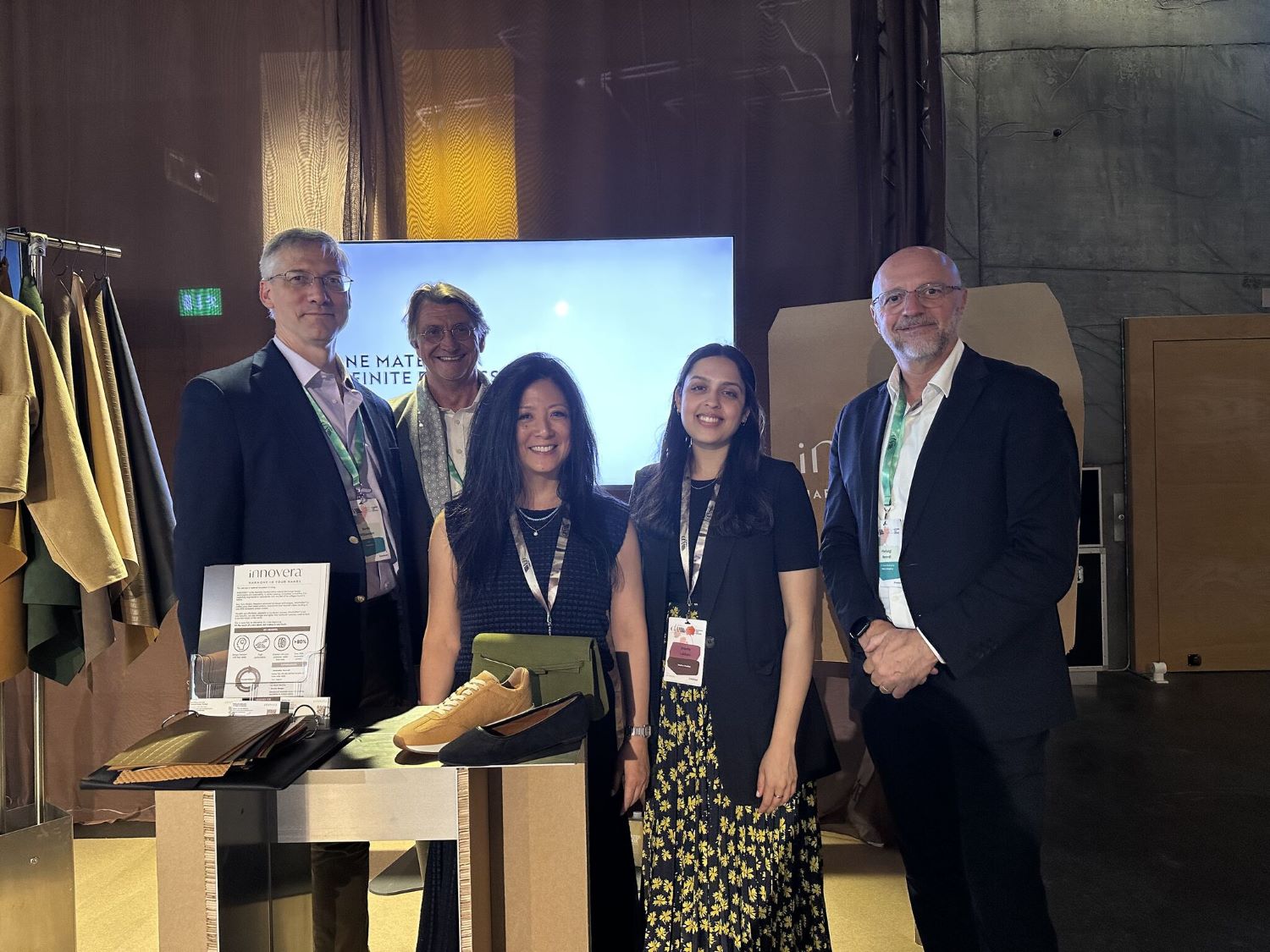
Another standout innovation is INNOVERA™, formerly known as BIO-VERA®, which serves as a high-performance alternative to leather. Designed to integrate seamlessly into existing manufacturing infrastructure, INNOVERA™ offers a premium look and feel, exceptional durability, and a significantly reduced environmental footprint.
Its compatibility with current tanning processes makes it especially attractive to manufacturers looking to adopt sustainable materials without major capital investment.
“INNOVERATM stands out because it doesn’t ask manufacturers or consumers to compromise on performance in order to achieve sustainability. Unlike many alternative materials that sacrifice durability or aesthetics, it is engineered to match and even surpass natural materials in strength, toughness and reduced weight,” Modern Meadow CEO David Williamson explained.
Modern Meadow’s Journey to Draw Attention from Global Brands
In 2022, Modern Meadow began to see its materials adopted by forward-thinking fashion brands. One of the first was Senreve, a luxury accessories company that launched a collection using Bio-Tex, a sustainable, animal-free leather alternative.
The collection featured popular models like the Cadence Crossbody and Midi Maestra, crafted with 100% traceable materials developed in the U.S. and finished in Italy. This collaboration demonstrated how biotechnology and traditional craftsmanship could coexist to create premium, sustainable products.
Later that same year, Everlane, a brand known for its ethical and transparent practices, introduced the New Day Market Tote using Bio-Tex. This partnership emphasized the material’s ability to replicate the look and feel of Italian leather while being made from renewable plant-based sources. It was a significant step in bringing sustainable biomaterials to a broader, more mainstream audience.
In 2023, Tory Burch joined the movement by reimagining its iconic Ella Tote as the Ella Bio Bag, using Bio-Tex with 64% USDA-certified bio-based content. The bag retained its luxury appeal while significantly reducing its environmental footprint. This collaboration highlighted the growing demand among high-end fashion brands for sustainable alternatives that do not compromise on quality or aesthetics.
By 2025, Modern Meadow had expanded its reach beyond fashion into the accessories and automotive sectors.
In April, Bellroy, an Australian brand known for its commitment to sustainability, announced a partnership to use INNOVERA—a next-generation leather alternative made from plant-based proteins, biopolymers, and post-consumer waste. INNOVERA offers over 80% renewable carbon content and is engineered to be twice as strong as traditional leather. Bellroy’s first products using this material are expected to launch in late 2025.
In June 2025, Modern Meadow entered the automotive space through a collaboration with Mercedes-Benz. The luxury automaker integrated INNOVERA into its CONCEPT AMG GT XX program, using the material for vehicle interiors.
This version of INNOVERA includes recycled racing tires and plant-based inputs, offering a customizable, animal-free solution that fits seamlessly into existing manufacturing processes. The partnership reflects a growing trend in the automotive industry toward sustainable luxury materials.
The Bet to Head to Sustainable World
Modern Meadow has raised a total of $184 million in funding, positioning itself as one of the most well-capitalized companies in the biofabricated materials space. Since its founding in 2011, the company has attracted a diverse group of investors who share its vision for a more sustainable and animal-free future in materials science.
The company’s early funding rounds were led by prominent venture capital firms such as Horizons Ventures, Sequoia Capital, and Iconiq Capital, which supported the foundational research into biofabricated collagen and the development of its first material platform, Zoa™. These early investments enabled Modern Meadow to pivot from lab-grown meat to sustainable materials, laying the groundwork for its commercial strategy.
In 2016, Modern Meadow raised a $40 million Series B round, which helped accelerate the development of its proprietary biofabrication technologies and scale up its R&D capabilities. This round was a turning point, allowing the company to move from lab-scale innovation to early-stage product development and brand collaborations.
The most significant milestone came in 2021, when Modern Meadow secured $130 million in a Series C round led by Key Partners Capital, with participation from Astanor Ventures and other strategic investors. This infusion of capital was instrumental in expanding the company’s commercial operations, scaling production capacity, and launching partnerships with global brands such as Tory Burch, Everlane, and Senreve.
In the years that followed, Modern Meadow continued to attract late-stage venture capital, including a Series D round in 2023, as it prepared to enter new markets like automotive interiors.
By 2025, the company had built a robust investor base of over 30 institutional backers, reflecting strong confidence in its long-term potential and the scalability of its biomaterial platforms, BIO-ALLOY and INNOVERA.
The Challenges that They Need to Overcome
As shared by David Williamson, moving away from traditional materials—especially animal leather—comes with real challenges. These include cost concerns, since sustainable alternatives can be more expensive to develop and scale. There’s also the issue of performance: any new material has to meet the same expectations as leather in terms of durability, feel, and look. On top of that, much of the fashion industry’s infrastructure is built around processing conventional materials, making change a slow and complex process.
However, despite these hurdles, there’s a noticeable and growing shift in the fashion world. Both luxury brands and mainstream retailers are increasingly adopting sustainable materials. This trend is setting a new standard across the industry, proving that eco-conscious alternatives are no longer niche—they’re becoming the norm.
“The shift away from traditional materials, particularly animal leather, presents challenges—including cost considerations, performance expectations, and industry-wide infrastructure. However, the rapid adoption of sustainable materials by high-end and mass-market fashion will set a precedence that proves that brands are increasingly prioritizing eco-conscious alternatives,” he stated.